
As we navigate the early months of 2026, the promise of the “Smart Home” has finally fully matured. Our houses are no longer just structures of brick and mortar; they are interconnected ecosystems capable of predicting our needs. However, this convenience has brought an unwelcome guest into our living rooms: the skyrocketing utility bill. Consequently, homeowners across the globe are discovering that their always-on AI assistants, predictive smart appliances, and integrated 4K security systems are consuming “phantom power” at record-breaking levels. Therefore, mastering smart energy management 2026 is no longer just a hobby for the eco-conscious; it has become a vital survival skill for protecting your monthly disposable income.
The Technical Reality: Why AI Homes are Power Hungry
In previous years, a “smart” device was largely passive. Today, in 2026, generative AI integration means your devices are constantly “thinking” in the background. Your smart refrigerator isn’t just keeping milk cold; it is running local vision models to track inventory. Your AI hub isn’t just waiting for a command; it is processing Natural Language Processing (NLP) wake-words in real-time. Primarily, this creates a heavy “baseload” of electricity usage—a constant stream of power that never hits zero. This invisible drain is a core reason why everyday life is getting more expensive for the average modern family. Furthermore, the transition to Edge Computing—where devices process data locally for privacy—means they require more robust, power-hungry processors running 24/7.
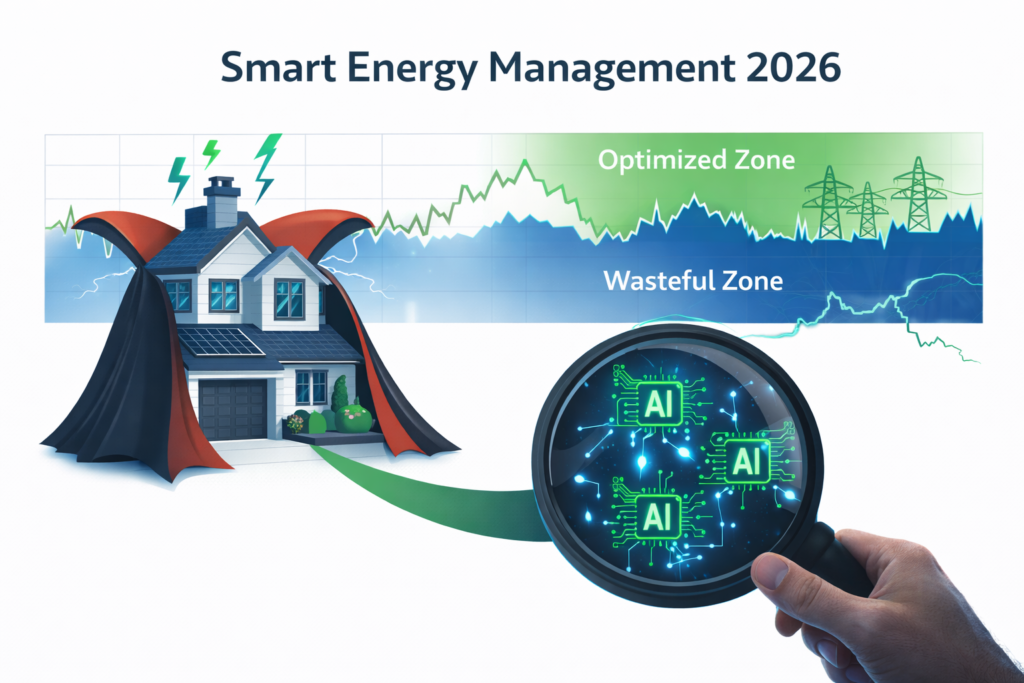
The Unique Metaphor: The “Energy Vampire in the Walls”
To truly grasp the necessity of smart energy management 2026, one must visualize their home as a “Digital Organism.”
“In the late 20th century, a house slept when its occupants did. In 2026, your house is a perpetual insomniac. It is like a high-performance elite athlete that never stops running a mental marathon. Even when your lights are dimmed and your family is asleep, the ‘digital heart’ of your AI servers, smart hubs, and mesh routers is beating with high frequency, consuming energy like a vampire that doesn’t need an invitation—it’s already been living in your walls since the day you synced your first smart bulb.”
Specifically, these energy vampires can account for up to 25% of a modern household’s total power consumption. When we consider that saving money feels harder than ever in 2026, identifying these silent drainers becomes the most effective ‘raise’ you can give yourself. Nevertheless, the solution isn’t to go back to the dark ages, but to leverage the very technology causing the problem. By using AI personal finance tools that integrate directly with your home’s smart meter, you can fight digital fire with digital water.
The Economic Impact: Inflation vs. Intelligence
We must also look at the broader economic landscape of 2026. Utility companies have shifted to aggressive “dynamic pricing” models, where electricity costs can triple during peak evening hours. Moreover, smart homes that aren’t optimized often pull the most power exactly when it is most expensive. In addition, the cumulative effect of dozens of small devices—each pulling just 5 to 10 watts—can add over $100 to a monthly bill. By contrast, a home optimized for smart energy management 2026 uses automated load-shifting to move heavy processing tasks to the middle of the night when rates are at their lowest.
[Detailed Action Guide] 2026 Smart Home Energy Audit
To help you reclaim your budget, we have compiled the definitive 2026 roadmap for home energy optimization. Implementing just two of these steps can lead to immediate, visible savings on your next statement.
| Phase | Action Item & Technical Step | Financial Impact | Effort Level |
|---|---|---|---|
| 1. Identify | Install an AI-powered circuit monitor (e.g., Sense 2.0) to categorize “Always On” loads vs. active use. | 15% reduction through awareness | Medium (Pro Install) |
| 2. Hibernate | Configure your AI hubs (Alexa/Google/HomePod) to ‘Deep Sleep’ via a smart plug schedule between 12 AM and 6 AM. | $15 – $30 Monthly | Easy (Set & Forget) |
| 3. Optimize | Shift ‘Heavy Data’ tasks (Cloud backups, security footage uploads) to off-peak utility hours. | Significant Peak-Rate Savings | Medium (App Settings) |
| 4. Consolidate | Upgrade to a single ‘Thread/Matter’ border router to eliminate the need for 5+ separate bridge devices. | $10 Monthly in Phantom Power | Hard (Hardware Swap) |
Looking Ahead: The Future of Responsible Intelligence
As we move further into 2026, the trend of “Green AI” is expected to take center stage. Manufacturers are beginning to release hardware that prioritizes watt-per-task efficiency. However, until these devices become the standard, the burden of smart energy management 2026 remains with the consumer. Ultimately, the “Smart Home” should be an asset that serves your lifestyle, not a liability that drains your savings.
In conclusion, taming the energy vampire requires a shift in mindset. Specifically, we must move from being passive users of technology to being active governors of our household infrastructure. Ultimately, those who apply these strategies today will not only enjoy a smarter home but a significantly more resilient financial future.